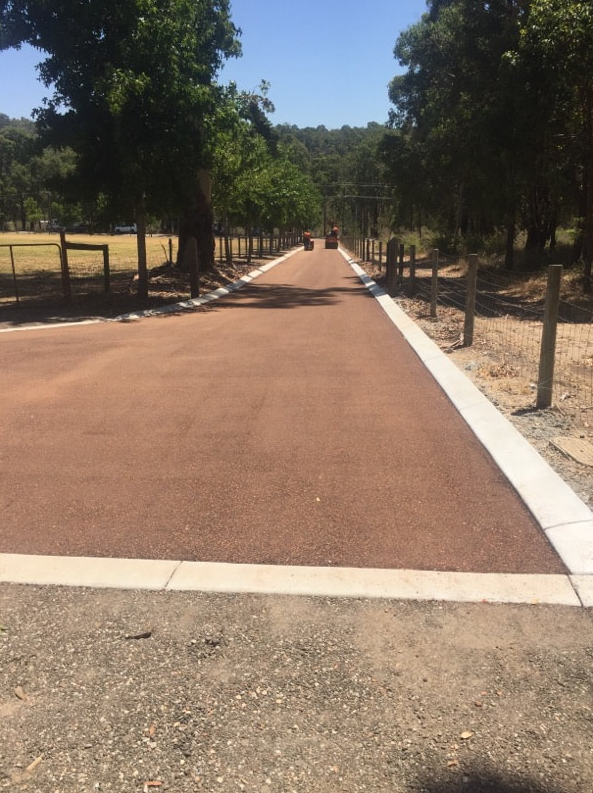
An access road can gradually deteriorate without reaching a point where it becomes completely unusable. Small potholes, shallow wheel ruts, drainage problems and loose sections can appear progressively, leaving property owners adapting to worsening conditions rather than addressing the road as a complete pavement.
For properties in Tumut, NSW, recognising the early signs of deterioration can help determine when routine maintenance is no longer enough. Professional improvement may involve grading, repairing failed areas, strengthening the pavement, improving drainage or installing an asphalt or bitumen surface, depending on the existing road and how it is used.
Here are nine signs that an access road deserves professional assessment.
1. Potholes Keep Returning After Repairs
An occasional pothole can be a localised maintenance issue. Potholes that continually return in the same sections suggest there may be a deeper problem.
Potholes commonly develop where the pavement has lost support. Water can enter through cracks or loose material and affect the foundation underneath. Passing vehicles then place repeated loads on the weakened area, eventually causing the surface to break apart.
Simply filling the visible hole may provide limited improvement if unstable material remains underneath.
Recurring potholes should therefore be assessed for underlying causes such as poor drainage, weak pavement foundations, insufficient compaction or concentrated vehicle loading.
Where necessary, the failed section can be removed and rebuilt onto stable support before the surface is restored.
2. Wheel Ruts Are Becoming Deeper
Wheel ruts are a particularly useful indication of how an access road is responding to regular traffic.
Vehicles generally follow similar paths each time they use a road. These wheel paths receive concentrated loading and can begin sinking if the pavement underneath is unable to provide sufficient support.
Minor surface marks are different from deep or progressively worsening ruts.
Where substantial deformation has developed, simply smoothing the top of the road may not correct the underlying weakness.
Professional assessment can determine whether the road needs grading, additional pavement material, improved compaction or more extensive reconstruction before surfacing.
3. Water Regularly Collects on the Road
Standing water is one of the clearest signs that an access road may need improvement.
A properly shaped road should encourage rainfall to move away from vehicle paths rather than remain in depressions. When water repeatedly collects in the same locations, the road may have lost its appropriate crossfall or developed low areas through settlement and traffic.
Water can also contribute to further deterioration.
If moisture reaches vulnerable pavement materials, the road can lose stability. Vehicle traffic then disturbs the weakened areas, leading to rutting, potholes and surface breakup.
Professional grading can help restore appropriate road levels, while more substantial drainage or pavement work may be required where deterioration has already progressed.
4. Vehicles Are Regularly Avoiding Particular Sections
Driver behaviour can reveal road problems that are easy to overlook.
If vehicles consistently move towards one side of an access road to avoid potholes, deep ruts, soft areas or rough sections, the usable part of the road is effectively becoming narrower.
This can also shift traffic loads onto areas that were not intended to carry most vehicle movements.
Over time, those alternative wheel paths may begin deteriorating as well.
When drivers need to weave around defects rather than follow a straightforward route, it is usually worth assessing the road as a complete surface rather than continuing with isolated repairs.
5. The Road Has Become Rough and Uncomfortable to Drive Over
An access road does not need to contain major potholes before its condition becomes a problem.
Widespread corrugations, loose material, uneven levels and numerous small defects can create a rough driving surface.
The appropriate treatment depends on what is causing the irregularity.
An unsealed road with a fundamentally stable foundation may benefit from professional grading and compaction. A road that continually becomes rough despite repeated maintenance may require a more substantial pavement upgrade.
Where conditions are suitable, asphalt or bitumen surfacing can create a more consistent wearing surface and reduce many of the problems associated with loose material.
6. The Edges Are Breaking Away
Road edges are sometimes overlooked because most vehicle traffic occurs towards the centre of the pavement.
However, deteriorating edges can be an important sign of declining road condition.
Erosion, inadequate support and vehicles travelling close to the boundary can cause edge material to move or break away. Water flowing along the road can accelerate this process.
Once edge support is lost, cracking and deterioration can progress further into the travelled surface.
Professional road improvement should therefore consider the full pavement width, including how the edges are supported and how water moves alongside them.
Repairing the centre of the road while ignoring deteriorating boundaries may leave an important weakness unresolved.
7. Maintenance Is Needed More and More Frequently
A road that requires occasional maintenance is not necessarily performing poorly. The more important question is whether the frequency of that work is increasing.
If grading is required increasingly often, potholes return shortly after being repaired or loose material continually moves out of wheel paths, the existing road may no longer be responding effectively to its current use.
Repeated maintenance can sometimes indicate that the treatment is addressing the symptoms rather than the underlying pavement condition.
A professional assessment can consider whether changes in traffic, drainage, foundation condition or surface deterioration are responsible.
The next step may involve strengthening particular sections, correcting levels or considering a more substantial surface improvement.
8. Traffic Has Changed Since the Road Was Constructed
An access road may have performed adequately for years before its condition begins declining more rapidly.
One possible reason is that the way the road is used has changed.
More frequent traffic, heavier vehicles or repeated use by machinery can place significantly different demands on the pavement. A road originally prepared for relatively light vehicle movements may begin showing rutting, potholes and foundation movement when subjected to heavier or more concentrated loads.
Turning, braking and acceleration can also create additional stress in particular locations.
When planning improvements, the road should therefore be assessed according to its current and expected use rather than simply restoring it to its previous condition.
9. Different Types of Damage Are Appearing at the Same Time
One of the strongest indications that broader road improvement should be considered is when several forms of deterioration appear together.
For example, the access road may have:
- Potholes in low sections
- Ruts along regular wheel paths
- Loose or displaced material
- Water collecting after rainfall
- Deteriorating edges
- Soft areas
- Uneven pavement levels
Individually, some of these problems may be manageable through localised maintenance. When they occur across several sections of the same road, they can indicate that the pavement should be assessed more comprehensively.
The objective is to determine whether individual repairs remain appropriate or whether the road would benefit from broader preparation and surfacing work.
Does Every Deteriorating Access Road Need Asphalt Surfacing?
Not necessarily.
The appropriate improvement depends on the condition of the existing road, its intended use and the performance expected from it.
Some unsealed access roads may respond well to professional grading, reshaping and compaction where the pavement structure remains suitable. Others may require additional preparation because the foundation has become unstable.
Where a more permanent bound wearing surface is appropriate, asphalt or bitumen surfacing can be considered after the road has been correctly prepared.
A professional contractor should recommend the treatment according to the actual pavement rather than assuming every road requires the same solution.
Why Grading Can Be an Important Part of Road Improvement
Grading does more than make a road look smoother.
Professional grading can reshape the pavement, remove irregularities and establish appropriate falls for water movement. It can also help prepare a consistent foundation before additional pavement material or surfacing is installed.
However, grading cannot correct every form of deterioration.
If deep sections of the pavement have failed, simply reshaping the surface may provide only temporary improvement. Unstable areas may need to be excavated and reconstructed first.
Understanding this distinction is important when an access road has already undergone repeated grading without lasting improvement.
When Could Asphalt or Bitumen Surfacing Be Appropriate?
A surfaced access road can provide a stable, consistent wearing layer for regular vehicle movements.
It may be worth considering where an existing road is structurally suitable for upgrading but continually experiences problems associated with an unsealed surface.
Before asphalt or bitumen is installed, however, the road needs suitable preparation.
Potholes and unstable sections should be corrected, the pavement needs adequate compaction, and grading should establish the required levels and drainage.
Surfacing should be the final part of a properly prepared pavement rather than a way of covering existing structural problems.
Why the Road Base Matters
Regardless of the final surface, a dependable access road requires stable support underneath.
The road base distributes vehicle loads through the pavement. If it becomes weak, poorly compacted or moisture affected, the surface above can begin moving.
This can result in rutting, settlement and potholes even if the visible wearing surface initially appears sound.
Professional road improvement therefore starts by considering the pavement as a complete system.
Where the base remains suitable, improvement may focus on grading, localised repairs and surfacing. Where substantial foundation deterioration exists, deeper preparation may be necessary.
Improving Drainage Can Protect the Road
Water management should form part of any substantial access road improvement.
Surface falls need to direct water away from the main travelled areas. Low points that continually hold water should be investigated, particularly where potholes or soft pavement have developed nearby.
Drainage conditions alongside the road also matter.
If runoff continually travels along vulnerable edges or enters the pavement from surrounding areas, repairing surface defects alone may not prevent deterioration from returning.
Considering drainage during preparation helps create a road that functions as a complete pavement rather than simply providing a smoother surface.
Professional Assessment Helps Avoid Repeated Short-Term Repairs
It can be difficult to determine the condition of an access road by looking only at its worst defect.
One large pothole may be a localised problem, while a relatively smooth-looking road could contain weak areas underneath.
A professional contractor can assess the road’s surface condition, foundation stability, drainage, traffic patterns, pavement levels and previous repairs.
This provides a clearer basis for deciding whether the road needs grading, localised reconstruction, broader pavement preparation or asphalt and bitumen surfacing.
For access roads in Tumut, assessing the complete route can be particularly valuable when deterioration has started appearing in several different forms.
Conclusion
An access road may need professional improvement when potholes repeatedly return, wheel ruts become deeper, water collects across the surface, edges deteriorate or vehicles begin avoiding damaged sections. Increasing maintenance requirements, changing traffic demands and several forms of deterioration occurring together are further signs that isolated repairs may no longer be enough.
The appropriate solution depends on the underlying condition of the road. Some surfaces may benefit from grading and compaction, while others require foundation repairs, drainage improvements or preparation for asphalt or bitumen surfacing.
If an access road in Tumut, NSW is becoming rough, unstable or increasingly difficult to maintain, Tumut Road Tek can assess the existing pavement and determine an appropriate improvement approach. Contact our team to discuss the condition of your access road and the work required to create a more stable, dependable surface.
Call us on: 02 5926 2530
Click here to find out more about Tumut Road Tek
Click here to complete our contact form and see how we can help with your Asphalt and Bitumen Surfacing needs.